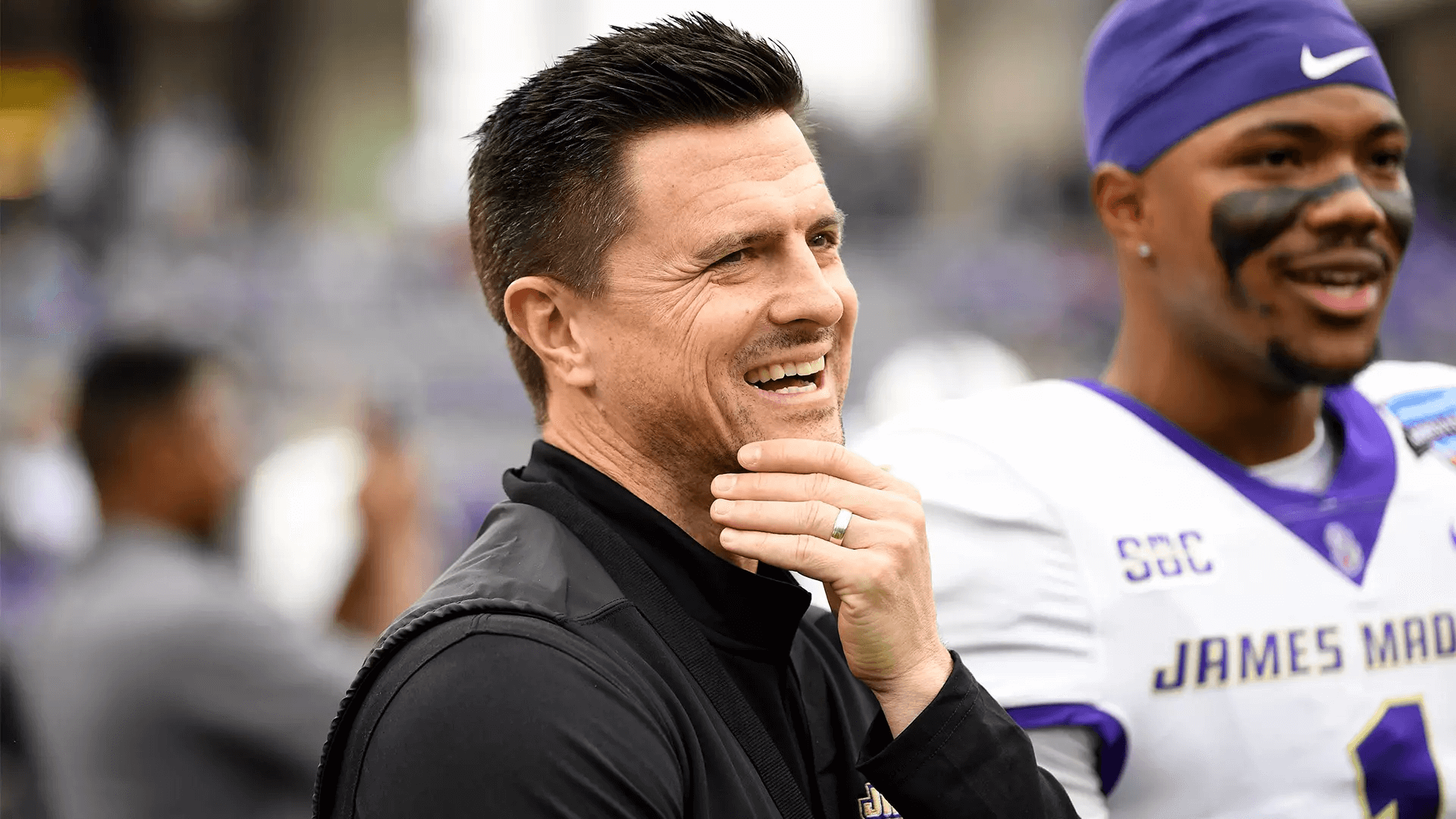
Former JMU coach Bob Chesney went on the Bill Simmons podcast, primarily to discuss UCLA and Holy Cross — Simmons lives in LA and is a Holy Cross alumnus— but the coach said a few interesting things about the Dukes.
Here are a few quotes that stood out.
JMU’s roster budget
The quote: “We walked into Oregon with a roster of about $400,000.”
Oh! Oh?
The Athletic reported during JMU’s CFP run that the Dukes spent about $1.5-2 million on the roster. Chesney’s quote suggests it was much less — and he suggested he had $250,000 to work with in 2024.
It’s unclear what led to the significant discrepancy between figures.
Regardless of specifics, JMU is working with less money than the best programs in college football, which is no surprise. Some teams pay more for their QB than the Dukes pay for their entire roster. Several Big Ten teams are spending more than $40 million on their rosters this season, according to reporting from CBS Sports.
It’s a sobering reminder of the gap between the haves and the have nots, one that seems to widen every year. JMU’s “moneyball” approach can work, but it still has to try to maximize its revenue-sharing potential to compete with Group of Six powers.
For JMU to have sustained success in the FBS, the Dukes need to get their money up. That’s the truth, whether they’re building from $400,000 or $2 million.
On the plus side, the Dukes have done exceedingly well to find players who value JMU’s opportunity more than just the finances. Doing that long-term is a challenge, but it’s a big reason why the Dukes keep grabbing FCS standouts in the portal every year.
“It was the right kids that had a chip on their shoulder and wanted to do things nobody thought they could do. … Those were the kids who worked in our program,” Chesney said.
Working with agents at JMU
The quote: “I was the one talking to all the agents … it was like four or five or six phone calls with every guy until you could even get near a number. I was at the point of, ‘This is really hard work.’ Obviously having a GM, an assistant GM, and a recruiting department is necessity at this stage of the game.
This one speaks partially to why Billy Napier makes so much sense as JMU’s replacement for Chesney. Napier is often praised by Florida administration, even after his firing, for bolstering the school’s football infrastructure.
He’s trying to do the same at JMU.
It starts by having Associate A.D. for Football Personnel Jacob LaFrance and others lead the recruiting and evaluation process. Instead of JMU’s head coach having to deal with agents all day during the portal period, LaFrance and his staff take the lead. This isn’t a groundbreaking setup, but the Dukes lagged behind in the recruiting department when making the FBS leap.
Curt Cignetti and Chesney being expert evaluators helped mask some of the shortcomings in JMU’s recruiting setup. Napier has the experience to fix some of those issues.
On deciding to leave Holy Cross for JMU
The quote: “It took a while. I remember my wife like watching these people track flights of where the AD is flying to. I did my interview, they came to my house. I was like, ‘Great, I think we killed it.’ … It was like three, four, five days later [in Vegas]. I called my agent, and I was like, ‘Let’s not do this. I’m just gonna stay at Holy Cross. These guys aren’t calling me back. They don’t see it the way I see it. This ain’t gonna work.’ As soon as I hung up with him, the search firm called me.”
Chesney had second thoughts about leaving Holy Cross up until his decision to join JMU. He felt an attachment to the area and school, and the interview process with JMU left him questioning the fit briefly.
It’s a fascinating look into Chesney’s emotions during the search. JMU fans were eagerly tracking flights, wondering who could replace Cignetti. Even Chesney, who exudes confidence, had doubts during the process. Everyone was nervous, even UCLA’s new coach!
It all worked out in the end.
Among the other notable messages during his discussion about Holy Cross was his genuine love for Worcester, Massachusetts, and that program.
“I loved that town,” he said. He later added he wanted to win a national title at Holy Cross.
It seemed obvious at the time of Chesney’s FCS to FBS jump that he would only leave Holy Cross if he felt the next stop was going to prepare him to reach the highest levels of the sport. The Simmons interview drove that home.
Chesney left a career and life in the northeast — he spent a decade at two non-FBS schools in Worcester before joining JMU — for one of the most stable jobs in the Group of Five. I’m guessing that he (and his agent) never intended to be in Harrisonburg long. Once they made the FBS leap, they seemed to eye stardom.
At UCLA, the mix of finances, athletics, and academics could be enough to keep him in town for a while. If he leaves UCLA by his own decision, it’ll probably be for a blue blood with strong academics like Michigan or the NFL.
JMU was an enticing stepping stone for the rising star coach, and both sides benefited from the brief partnership.
Chesney’s likely glad he didn’t let his last-minute doubts hold him back. The Dukes are plenty glad his career made a pit stop in Virginia.
On the UCLA news breaking
The quote: “Probably 400 text messages in the first couple hours. I end up [showing a screenshot] during a team meeting, and I said, ‘I’m not answering a single one of these. These are all about next year.’”
Shortly after news broke that Chesney was leaving for UCLA, the coach wanted his team to know he was committed to the Dukes through the duration of the 2025 season. So he showed his team his unread texts about UCLA and promised not to view them until after the season. He would periodically show his team the updated unread text messages number as the final stages of the season (Sun Belt title game and the CFP run) continued. He says it quickly grew to well over 1,000 unread messages.
“It kept growing, and I was holding true to my word,” Chesney said.
It’s admirable that he wanted to finish the entire season, and his departure certainly differs from Cignetti’s clunkier exit. At one point Cignetti was going to coach the Dukes’ bowl game against Air Force, but both sides ultimately decided he’d skip it to focus fully on Indiana. It was a little messy.
“I’m not gonna leave this team,” Chesney told Simmons about possibly missing a playoff or bowl game.
JMU fans seem to largely respect Chesney and his time in Harrisonburg, and this helps explain why. He transitioned to UCLA professionally and with both JMU and the Bruins in mind.
He saw the season to its conclusion. He also claims he didn’t tamper with any JMU players prior to the portal opening. He even joked that some of the JMU guys in the portal thought he wasn’t interested in bringing them to UCLA because he reached out after the official opening date when other coaches had already contacted them.
“I wanted that to stay pure,” Chesney said.
JMU fans will obviously remember Chesney fondly for what his teams did on the field. But it’s the way he left that might endear him to the fanbase most.
Photo courtesy of JMU Athletics Communications
Leave a Reply