
The Florida Gators hired Billy Napier with the hope they’d contend with the SEC elites during his tenure. It didn’t happen.
Midway through Napier’s fourth season in Gainesville, the program fired him. He went 22-23 as the Gators’ coach, following a 40-12 run at Louisiana. Objectively, Napier failed at Florida.
But the highly successful Sun Belt coach comes to JMU with a history of dominating the Group of Six league. If he can learn from his Florida mistakes and rekindle his Louisiana success, Napier could be a home-run hire for the Dukes.
Here’s what he’s doing differently after four middling seasons in the SEC.
Giving up play-calling duties
Florida fans wanted Napier to give up play-calling toward the end of his tenure, but Napier was hesitant to do so. He’s changing his tune at JMU. He did so immediately, too.
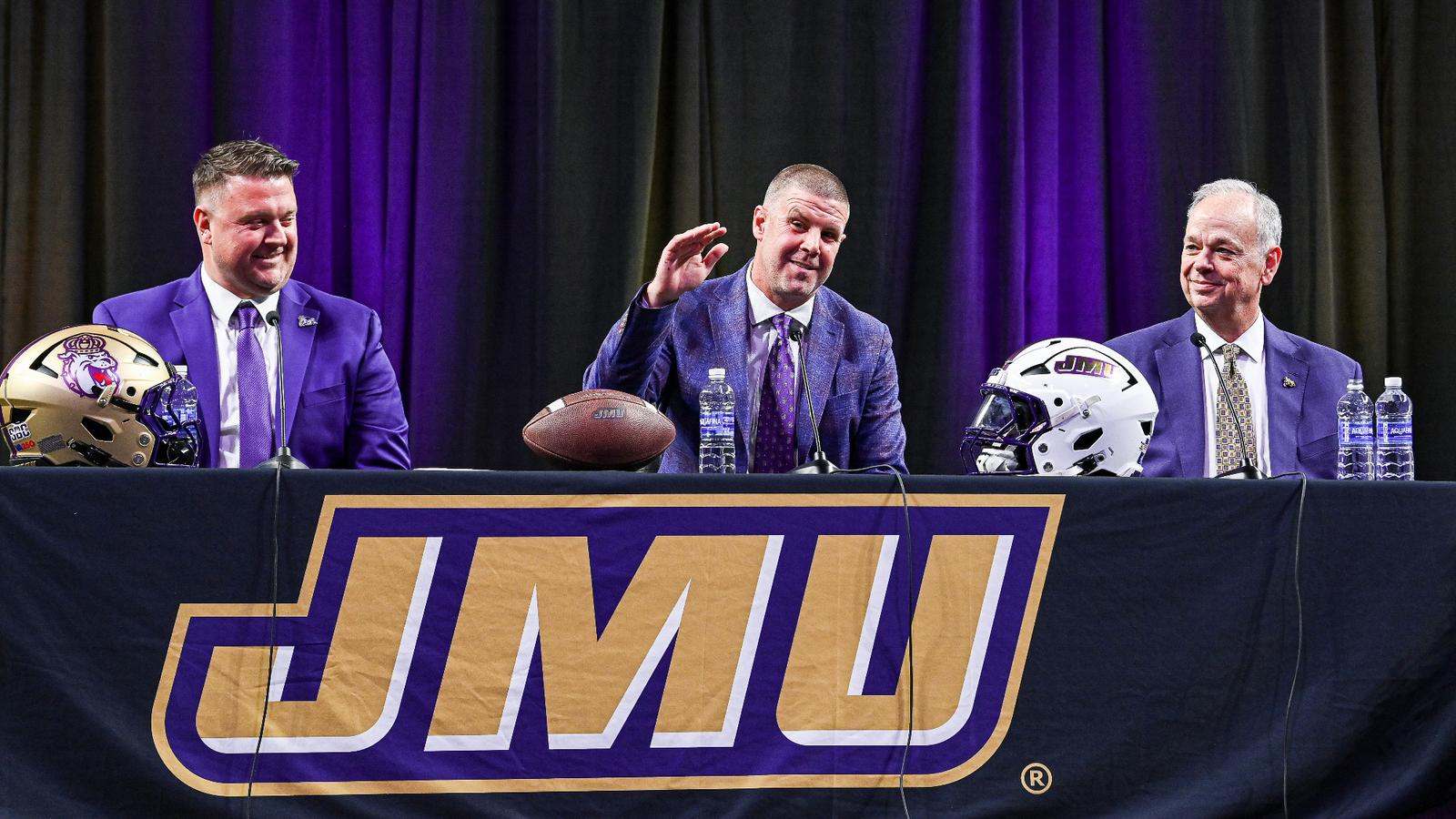
“I’m going to do it differently this time,” Napier told Dave Riggert the day of his introductory news conference in December. “I’m going to hire a coordinator. I’m going to work with him, but I’m going to give that guy autonomy, let him call the plays. I do think that I will go a little bit more pace. A little bit more 11 personnel, spread. I think at this level you can find the skill players. I think it’s hard to find the bigs, the tight ends.”
Napier has lived up to his December words in the following months.
New offensive coordinator Cam Aiken, who comes from ETSU and previously spent time as an assistant at Clemson and Ole Miss, gets the keys to the offense. He runs an up-tempo spread that ranked 15th in the FCS a season ago in total yards. Napier says giving up play-calling helps him spend more time with other units, allowing him to serve in more of a CEO role than working essentially as a head coach and offensive coordinator.
On paper, the move makes sense.
Aiken’s 2025 ETSU team scored 30 or more points in seven of 12 games last season despite a lackluster quarterback room. The unit did well against ranked teams, and it averaged 478 yards and 33.9 points per game in conference play. He’s a rising star at OC.
While the Dukes have the tight ends (Cole Keller, KD Mosley, Thatcher Miller, etc) needed to jump into 12 personnel (1 running back, 2 tight ends), they’re built to win from 11 personnel (1 running back, 1 tight end). The Dukes’ receivers, especially Corey Scott, Jeremiah Harrison, and Braeden Wisloski, are among the Sun Belt’s best. Running backs George Pettaway and Nick Herman have explosive potential with their speed.
Both quarterback options — Camden Coleman and JC Evans — are mobile with the ability to succeed on designed QB runs. The offense will play fast, and they specifically added linemen in the portal with experience running a speedy spread.
Florida fans were furious about Napier’s insistence on calling plays. After a period of reflection, Napier seems to be admitting they had a point. That serves as JMU’s gain.
Trusting his assistant coaches to lead
Perhaps the biggest change Napier has vocalized to the media is a desire to lean on others more than he feels he did at Florida. This means giving play-calling to Aiken and letting assistant coaches speak before the team, among other things.
“I did it at Louisiana,” Napier recently said of allowing assistants a bigger voice. “Then we were a little bit inconsistent in that use [at Florida.] I think I’ve got some head coaches on our staff. Leaders produce leaders. I felt like my four years at Florida, maybe that was an area I could’ve done better.”
From Napier’s preseason comments, he’s made it clear he wants to oversee JMU’s program more than meddling in every day-to-day action. He’s suggested that being so in the weeds at Florida kept him from being as productive as possible.
It’s something Florida’s high-ranking officials noticed.
“I shared with him I thought his strength may be in leading the program and overseeing the bigger picture, but my philosophy is you hire head coaches, you give them the authority to make decisions on how they want to run their program,” Florida AD Scott Stricklin said after Napier’s firing. “And then you hold them accountable, and that’s probably a big part of the reason why we’re here today.”
Napier also previously told On3 his Florida program struggled adjusting to NIL. To win at JMU, he’ll need to succeed as an evaluator and developer.
He’s stealing a page from Bob Chesney’s playbook, at least in the portal.
Led by Jacob LaFrance, the Dukes looked for lower-level production. They brought in a 1,000-yard rusher from Drake and a 1,000-yard receiver from West Florida in Scott. His West Florida teammate will play meaningful snaps on the defensive line. They added a Division III star (D.J. Fox) as a potential starting left tackle. A likely starter at defensive end comes from Lamar. One of the top incoming defensive backs played at the Division II level. Another played at Toledo.
Napier often says “success leaves clues.” Well, he’s straight up copying Chesney’s proven model in the portal. Power Conference teams often poach Group of Six stars. The Dukes are adding FCS and Division II and III superstars instead.
JMU’s new head coach is using his young coaching staff to mimic a Power Conference’s recruiting and development model.
“I think this is kind of a P4 moneyball approach,” Napier said on ESPN Richmond’s Fitz the Bill this offseason. “I think we’re built with the same infrastructure. We have the same job descriptions. We’re just a little bit younger, and we don’t pay as much. They’ve done a great job.”
There are fewer cooks in the kitchen, but Napier’s banking on that being a benefit. To stick with the corny restaurant analogy, he’s optimistic some of those cooks are on their way to becoming head chefs in the near future. Instead of trying to make every dish himself, Napier is stepping back and overseeing the kitchen.
TLDR: Napier is trusting his assistants to coach without micromanaging them.
Stabilizing the quarterback room
Perhaps the biggest determinant of any coach’s success, however, will come down to quarterback play. The Dukes added Arrington Maiden (Memphis) and Davi Belfort (UCF) via the portal. Belfort shifted to wide receiver, and Maiden was quickly ousted from the battle for the starting spot and will serve as QB3 behind Evans and Coleman.
It’s not exactly a ringing endorsement of the staff’s portal evaluation at the position, but it also doesn’t matter where they find their most productive quarterback. Chesney brought in high-profile transfers Dylan Morris and Matthew Sluka, and together they threw 12 passes over two seasons. The Dukes still won 21 games over the two seasons.
So how will Napier and his staff develop Evans or Coleman, who both have multiple seasons of eligibility left? First, they need to correctly identify the man for the job.
“I think it’s been a true, fair competition,” quarterbacks coach Aaron Pflugrad said recently. “They knew that going in that, ‘Hey, the man for the job is going to have to earn this thing.’ Coach Napier and myself would have it no other way.”
JMU hasn’t announced a starter, although signs point to Evans. They need to hope he makes good on their evaluation.
JMU’s 2023 evaluation under Curt Cignetti backfired, only for the Dukes and Alonza Barnett to be bailed out by good play from the Week 1 backup, Jordan McCloud. After taking over the starting job in Week 2, McCloud led the Dukes to double-digit wins and was among the nation’s most efficient passers.
If they’re wrong about Evans, can Coleman bail them out? What if both struggle? Can the defense and running game make up for it? Florida played great defense over the past two seasons, but the offensive inconsistency doomed the program. If nothing else, Napier has given the Dukes several options capable of delivering at the position in Year 1. He’s repeatedly stressed he thinks both players can play winning football.
“That position doesn’t worry me,” Napier told Dave Riggert in July.
A massive reason for JMU’s success since moving to the FBS has been the steady play of Todd Centeio, McCloud, and Barnett. Since 2022, that trio combined to throw 109 touchdown passes and just 28 interceptions. That makes for a season average of 27 passing TDs and seven interceptions. That’s high-level play.
If Napier and his staff can get high-level Sun Belt QB play, he should find much better success than he did at Florida.
DJ Lagway’s stunted development is among the main reasons Napier is back in the Sun Belt. He was expected to be an SEC standout, but instead threw 23 interceptions and just 28 touchdowns in two seasons. He completed 62% of his passes and struggled to avoid major mistakes. He threw five interceptions in a 20-10 loss to LSU early last season, adding to the calls for Napier to be fired.
Before becoming a head coach, Napier played and coached quarterback. It’s his thing. Cignetti was the same way, and his ability to maximize the position is why he landed a Big Ten job. It’s also why his Indiana team won a national title and produced the No. 1 overall pick in the NFL draft.
Napier doesn’t need to be Cignetti, but he also can’t have Lagway-esque results and expect the Dukes to rip off Sun Belt titles.
Can Billy Napier get elite quarterback play at JMU? The answer will define his tenure.
Photo courtesy of JMU Athletics Communications
Leave a Reply