
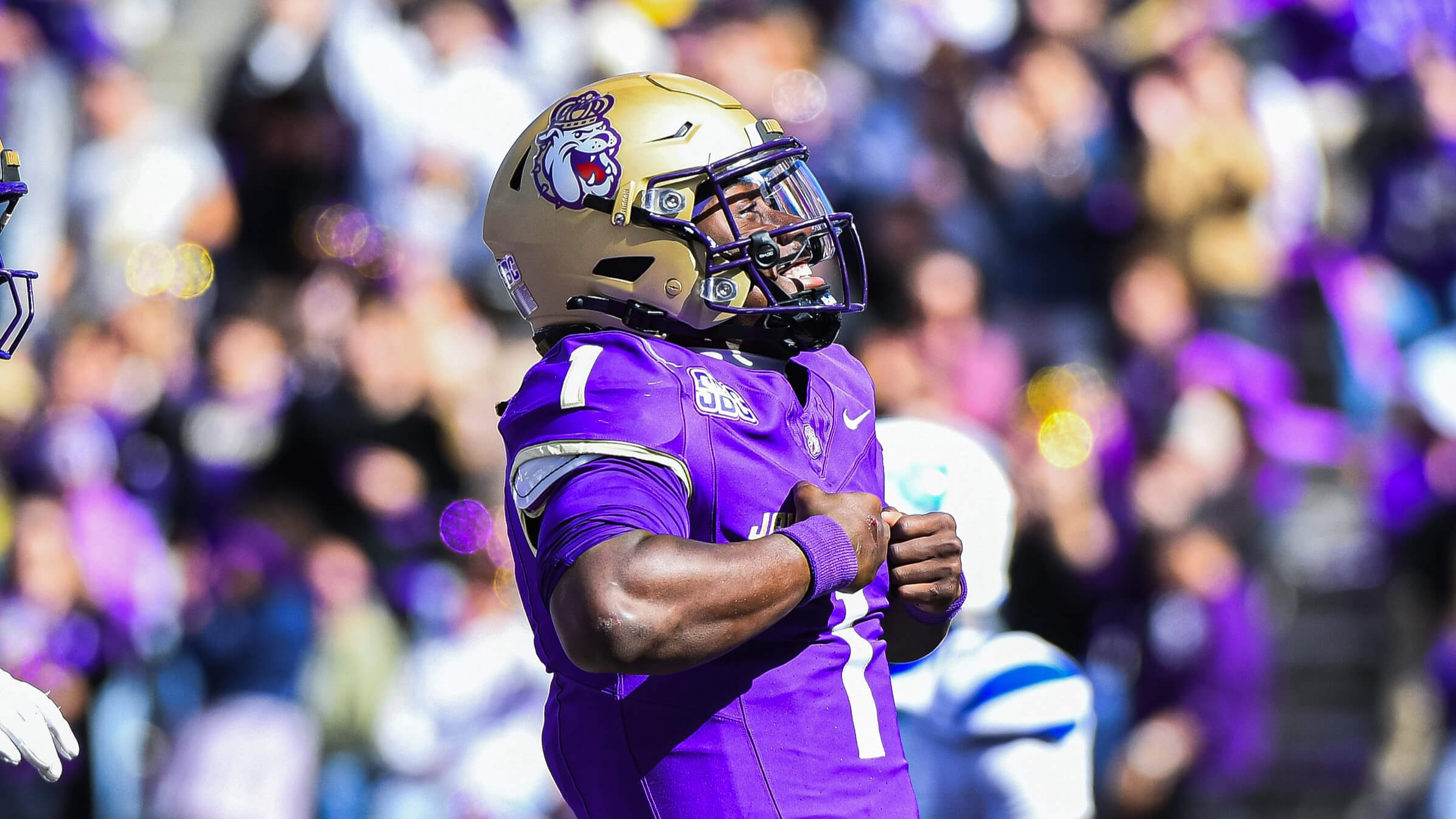
JMU’s two-quarterback system is largely working, and it’s hard to say it’s the reason the Dukes lost to App State. But it also brings up uncomfortable questions that need to be answered in the next two or three months.
In the 34-31 loss, the Dukes’ Camden Coleman and JC Evans completed 27 of their 46 passes for 331 yards, two touchdowns, and one interception. They also ran for a touchdown, although they only mustered 9 yards on nine carries. They were above average.
Evans was the more efficient passer, going 5-for-7 for 99 yards, including a 70-yard score. Coleman had his moments, too, although he also tossed a costly fourth-quarter interception deep in JMU territory.
Let’s start with the obvious: Both guys are really good.
The player breakdown
Evans’ 6’5 frame and athleticism make him an intriguing NFL prospect. He also has an 82 offensive grade on Pro Football Focus this season, which is exceptional. In limited passing opportunities, he’s created explosiveness and taken care of the football. He will draw major P4 interest if he enters the portal.
Evans looks like he has top-end ability.
On the season, he’s completed 18 of 26 passes for 298 yards and five touchdowns. Three of the eight incompletions were drops, per PFF. He’s also added 103 rushing yards and two scores on 27 runs.
Coleman hasn’t been as dynamic (70 PFF grade), with less natural rushing ability and inconsistencies as a passer. He has seven big-time throws, per PFF. He also has 12 turnover-worthy plays. He’s fortunate to have just two interceptions on the year.
You can’t argue with the counting stats, though. He has 1,567 passing yards, 14 touchdowns, and just two interceptions. The completion percentage of 61.7% isn’t great, but it’s fine, and PFF credits his WRs with 12 drops. He’s added 117 rushing yards and two scores on 40 runs.
He followed a similar trajectory in his first season at Richmond, posting a PFF grade in the low 70s before following it up with a spectacular grade in the mid-80s in his second season. Coleman’s strengths are that he’s above average at pretty much everything, from mobility to accuracy to arm strength to football IQ to leadership. He’s really, really good. A second year under Billy Napier and offensive coordinator Cam Aiken could do wonders for his development.
Who gives them the best chance to win in 2026?
This is a cop-out answer, but the current rotation should be fine for the rest of the season. JMU sits outside the group of College Football Playoff frontrunners given its strength of schedule. Making the CFP would require meltdowns from Boise State, New Mexico, Oregon State, UTSA, and others. It would speak more to the Group of Six’s lack of strength rather than JMU’s results if the Dukes somehow make the field.
The focus turns to winning a Sun Belt title. If App State drops one more league game — the Mountaineers will be a road underdog Saturday against Georgia Southern — JMU just needs to beat Troy, Southern Miss, and Coastal Carolina to win the East. That feels quite manageable.
And both quarterbacks should find success against those three opponents and nonconference foe UConn, which is far better offensively than on defense. JMU will be a huge favorite in all three conference games, with spreads likely close to three touchdowns.
The bigger question isn’t about the rest of this season, but rather the future of the program under Napier.
Who can they retain?
Roster retention is crucial, especially at the Group of 6 level. Given the likely turnover among the division, keeping key players gives teams a massive leg up on their peers.
Bob Chesney’s first JMU team was deeply inconsistent, going 9-4 and just 4-4 in conference games. But Chesney brought key players back in 2025. That includes quarterback Alonza Barnett, running back Wayne Knight, linebacker Trent Hendrick, and safety Jacob Thomas. Those guys — plus more returners and a solid portal haul — ensured that the Dukes entered the season with cohesion and warranted College Football Playoff expectations. They delivered a 12-1 record that sent them to the College Football Playoff.
That’s soon going to be the question facing Napier and his staff. Yes, the Dukes still have a chance to win the Sun Belt and an outside shot at the CFP this season. Those shouldn’t be brushed aside.
But how can they build upon this season to sustain success in the American Conference? It starts at quarterback.
JMU likely won’t go into 2027 with a two-quarterback system. For starters, it’s a little clunky to rotate guys across an entire season, but the bigger issue is pulling it off with revenue-sharing and NIL. Coleman and Evans are both valuable, and third-stringer Arrington Maiden doesn’t come free, either.
The Dukes will be fortunate to keep two of those three. Keeping one is a borderline necessity, though, and will be perhaps the program’s biggest offseason focus.
JMU can’t punt on its 2026 season, of course, but they should have at least an eye on the future when making its QB decisions. If Coleman is the more likely of the two players to return, he has to stay featured in the rotation. He’s gaining meaningful game reps in Napier and Aiken’s offense. If Evans has indicated he could return next fall, the Dukes need to give him a larger role in the passing game down the stretch. Keeping both players in 2027 would be incredible, but it feels like a pipe dream given the market rate for starting quarterbacks in the transfer portal.
How Napier manages the position over the coming months will give us insight into how 2027 might unfold.
Photo courtesy of JMU Athletics Communications
Leave a Reply